A dorm room may hold a bed, a desk, clothes, books, and the small items that make a new place feel familiar. Yet its floor area is often limited. A bulky dresser can block a drawer, while a chair left beside the bed may narrow the path to the door. Space-saving furniture helps by giving one item more than one job. A loft bed can create room for a desk below; a storage ottoman can hold linens and serve as extra seating. The goal is not to make the room look empty. It is to make everyday tasks easier.
Le Corbusier wrote, “A house is a machine for living in.” His idea offers a useful lens for dorm design: furniture should support how students sleep, study, store belongings, and move through the room. For anyone asking how to maximize space in small dormitory rooms, start by noticing what gets in the way each day. Measure the bed, door swing, and walkway before buying anything. Then consider folding, stackable, or under-bed storage pieces that fit those limits. Still, clever furniture cannot fix every problem. A loft bed may feel awkward, and too many organizers can create clutter of their own. That trade-off deserves thought. The best setup is practical, safe, and easy to change as routines evolve.
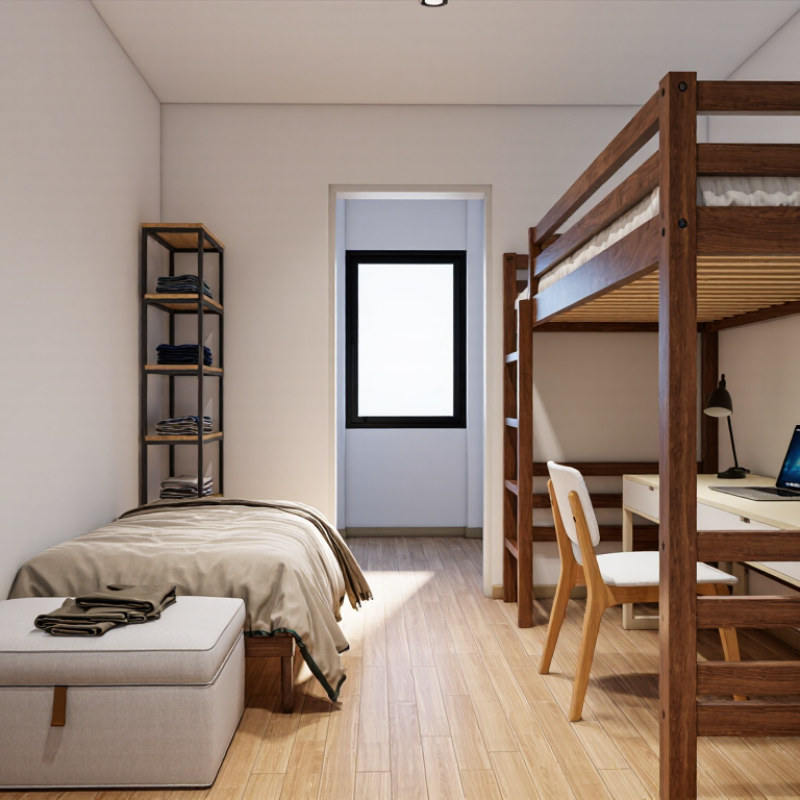
Small dorm rooms often have to fit a bed, desk, wardrobe, and sometimes a roommate’s belongings within one compact footprint. The exact layout varies by campus, so a single “standard” room size can be misleading. Still, the daily pinch points are familiar: a desk chair blocks the wardrobe, an open drawer narrows the walkway, and a suitcase ends up beside the bed. Every inch counts. The National Center for Education Statistics recorded about 15.4 million undergraduates at U.S. degree-granting institutions in fall 2022. That scale helps explain why campus housing must use space carefully, even though enrollment figures do not tell us how large individual rooms are.
Clearance matters as much as furniture dimensions. The U.S. Access Board’s 2010 ADA Standards specify a 36-inch minimum clear width for many accessible routes, with stated exceptions. This is an accessibility benchmark, not a universal dorm-room rule, but it shows how quickly a walkway can become too narrow. A bulky bed frame or a door swinging into the room can consume useful floor area before storage is added. Space-saving furniture can help by lifting a bed, combining a desk with shelving, or using drawers beneath a frame. Yet compact designs can also make items harder to reach. That trade-off is easy to overlook. Measure the door swing, walking path, and storage access before choosing furniture; a tidy floor plan that cannot be used comfortably is not much of a solution.
Typical planning examples for compact shared dorm rooms. Actual room and furniture measurements vary by residence hall; check the room dimensions and housing guidelines before purchasing.
| Space Constraint | Typical Planning Dimension | How It Limits the Room | Space-Saving Furniture Approach |
|---|---|---|---|
| Limited total floor area | Many compact double rooms are planned within roughly 180–250 sq. ft. (17–23 m²), including space shared by two residents. | Beds, desks, storage, and seating must share a small footprint, leaving less open floor space. | Choose furniture that serves more than one purpose, such as a storage ottoman or a desk with drawers. |
| Two bed footprints | A standard Twin XL mattress is approximately 38 × 80 in. (97 × 203 cm); two mattresses alone cover about 42 sq. ft. (3.9 m²). | Two beds can occupy a large portion of the usable floor, especially when placed side by side. | Use approved lofting or bunking arrangements where permitted, or position beds to preserve a clear central walkway. |
| Restricted bed clearance | A practical target is about 30 in. (76 cm) of clear passage where the room layout allows; accessibility requirements may call for more. | Oversized bedside tables or chairs can make routes between the door, beds, and desk difficult to use. | Use narrow bedside shelves, wall-mounted organizers, or compact rolling storage instead of bulky tables. |
| Small desk zone | A compact study desk is commonly around 36–48 in. wide and 20–24 in. deep (91–122 × 51–61 cm). | A full-size desk and chair can extend into the main walkway and compete with shared storage. | Select a desk with vertical shelving or built-in storage, and use a chair that tucks fully underneath. |
| Limited closet and drawer space | Closet width and built-in storage vary considerably; measure the available hanging width, shelf depth, and drawer space in the room. | Additional dressers may consume floor area needed for circulation and study. | Add stackable bins, under-bed containers, or hanging organizers, provided they do not block doors or vents. |
| Door swing and entry path | Interior doors are often about 28–36 in. wide (71–91 cm); the open door also needs room to swing. | Furniture placed near the entrance can obstruct access or prevent the door from opening fully. | Keep the door arc clear and favor slim, vertical storage near the entry rather than deep cabinets. |
| Windows, radiators, and outlets | Clearance needs depend on the room’s fixtures and housing rules; maintain the access and ventilation gaps specified by the residence hall. | Fixed features reduce usable wall space and can make some furniture positions impractical. | Use movable or modular pieces, and avoid covering windows, heaters, electrical outlets, or required access routes. |
| Shared room circulation | Plan a continuous route between the entrance, each resident’s sleeping area, and shared facilities. | Loose furniture and personal belongings can quickly narrow common paths in a double room. | Agree on a shared layout, use labeled vertical storage, and choose foldable seating that can be put away when not in use. |
It gives one area several roles. A storage bench can hold books by day and serve as a bedside table at night.
Measure the bed, desk, doorway, and walking path. Check that drawers open fully beside the wall.
Yes. It can fold against the wall, leaving room for stretching or laundry. Measure its folded depth, too.
Bed risers can lift the bed for storage bins. Under-bed drawers may also work, if they clear the frame.
Not always. Check ceiling height and campus rules first. A low ceiling can make the setup uncomfortable.
Consider nesting tables, slim wardrobes, storage ottomans, and folding chairs. Keep daily items within easy reach.
No. A sofa bed may save space, but folding it every day can become irritating. The clever option may stay unused.
Give each bin or ottoman a clear purpose. Label seasonal clothing bins. I may still let one become a catch-all.
Small dorm rooms often have to accommodate sleeping, studying, storage, and relaxation within a limited floor area. When bulky or single-purpose items fill the room, it can feel crowded and become harder to move around. Space-saving furniture helps address these challenges by using compact forms, vertical storage, and designs that serve more than one purpose. A lofted bed with room beneath it, a desk with built-in shelves, or a storage ottoman can make everyday activities fit more comfortably into the same space.
Choosing suitable furniture is an important part of how to maximize space in small dormitory rooms. Consider the room’s measurements, layout, storage needs, and how each item will be used throughout the day. Foldable or stackable pieces may offer flexibility, while multifunctional options can reduce the number of separate furnishings required. By prioritizing practical dimensions, easy movement, and useful storage, students can create a dorm room that feels organized and functional without sacrificing comfort.

 Rimkok Furniture