Choosing a school desk top is not simply a matter of comparing prices. Daily use brings pencil scratches, spilled water, sharp compass points, and repeated cleaning. The right material must tolerate these small attacks for years. That is why many buyers ask, “what is the difference between HPL and MDF for school desk tops?”
Dr. Robert H. Falk, a wood-products engineer associated with the USDA Forest Products Laboratory, explains, “MDF offers a smooth, uniform surface, but moisture resistance depends on the product and its edge protection.” His observation is practical. MDF is an engineered wood panel with a dense, even face. HPL is a hard decorative laminate, usually bonded over a stable core. HPL can resist abrasion, stains, and frequent wiping well. MDF usually provides the structure beneath the surface, rather than acting as the exposed working layer.
The details matter. A classroom desk with sealed HPL edges may survive years of writing and cleaning. An exposed MDF edge can swell after one unnoticed spill. That sounds minor. It is not. Yet HPL is not automatically perfect; poor bonding, weak cores, or badly finished edges can still cause failure. Some claims about “waterproof” panels also deserve careful questioning.
This guide compares seven practical points, including durability, moisture behavior, safety, maintenance, appearance, cost, and repairability. It also recognizes an uncomfortable truth: the best choice depends on construction quality, not material names alone. A cheaper desk may perform better when its edges, joints, and core are properly engineered.
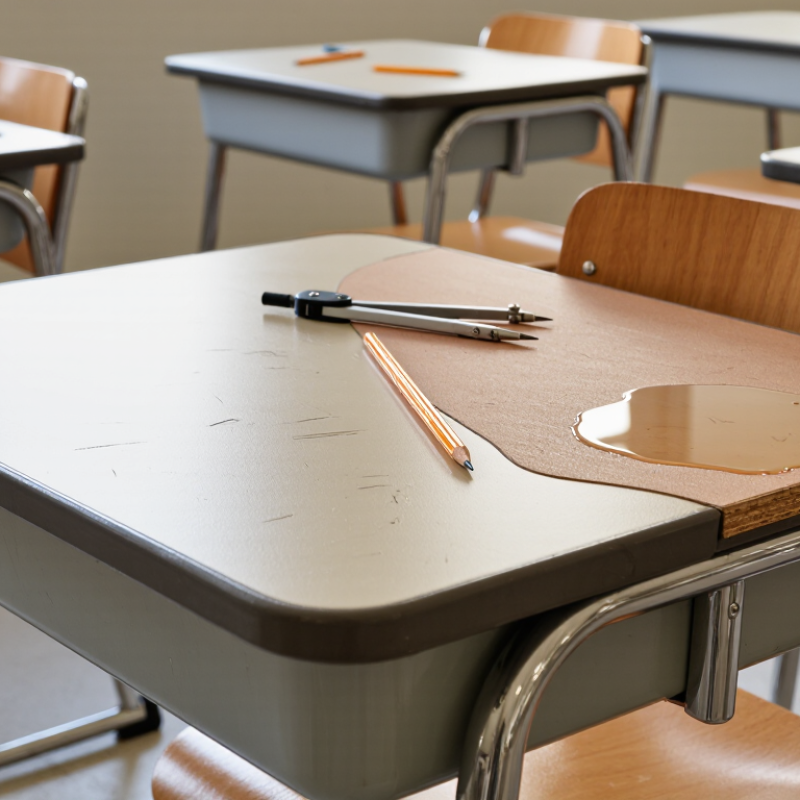
HPL means High-Pressure Laminate, while MDF means Medium-Density Fibreboard. A school desktop commonly uses 0.8–1.2 mm HPL over 600–800 kg/m³ MDF. HPL provides the working surface. MDF provides thickness, stability, and machining strength. The FAO’s Global Forest Products Facts and Figures 2023 reports nearly 390 million m³ of global wood-based panel production. That scale supports MDF’s established industrial supply, but not every panel has equal quality.
Tip one: choose HPL with tested abrasion resistance.
Tip two: inspect the laminate edge carefully.
Tip three: use moisture-resistant MDF near sinks or damp classrooms.
Tip four: specify sealed edges, especially around cut-outs.
EN 438-2:2016 includes methods for abrasion, impact, and resistance testing. EN 622-5 classifies MDF performance requirements. Ask for current test documents, not only sales claims. Small details matter.
Tip five: check the adhesive system and pressing quality.
Tip six: avoid exposed MDF beneath pencil grooves or damaged corners.
Tip seven: compare total service life, not purchase price.
In practical school use, HPL usually resists scratches, stains, and repeated cleaning better than unfinished MDF. Yet HPL can chip at poorly protected edges. I would not call it indestructible. One overlooked detail remains troubling: a dense MDF core may still swell after prolonged water exposure. A sample test with wet cloths, rounded objects, and daily cleaning often reveals more than a brochure.
HPL and MDF solve different problems on a school desk. HPL protects the working surface, while MDF supplies the structural core. EN 438-2:2016 measures laminate abrasion through defined revolutions. Common performance thresholds include 350, 500, and 1,000 revolutions. Higher ratings usually suit classrooms with constant writing, sliding books, and frequent cleaning. Abrasion is not impact resistance, however. A sharp pencil case can still chip a weak edge.
MDF performance depends on density, thickness, moisture resistance, and edge support. EN 622-5 specifies bending-strength requirements that commonly range from about 18 to 22 N/mm² for general-purpose MDF thicknesses. Internal bond requirements often begin near 0.55 N/mm², depending on the board category. These figures describe tested board samples, not a complete desk. Field inspections often show failures at exposed corners first. Poor sealing can allow moisture swelling, even when the HPL face remains attractive. Very thin MDF may also flex under concentrated loads. That detail is easy to miss.
For demanding classrooms, a wear-rated HPL surface bonded to adequately thick, well-supported MDF is usually the more balanced specification. Specify the EN 438 abrasion class, MDF grade, thickness, and edge treatment together. Do not judge durability by surface appearance alone. One practical weakness remains: test conditions rarely copy years of student use. Teachers may drag chairs against desks, and cleaners may use excessive pressure. Real service can be less predictable.
For school desktops, HPL usually handles surface moisture and heat better than exposed MDF. EN 438-2 evaluates HPL against dry heat, wet heat, water vapour, impact, and dimensional change. These tests give useful performance classes, but they do not promise unlimited service life. A hot lunch box can still leave a mark if heat remains trapped.
Edges matter.
MDF performs differently because its fibres absorb moisture quickly after edge damage. EN 622-5 separates MDF panels for general use from panels designed for humid conditions. Sealed edges reduce water entry, especially around screw holes and cut-outs. However, paint alone may be too thin for heavy classroom cleaning. A durable edge sealer, tight joints, and rounded corners provide better practical protection.
Independent panel testing should be requested before specifying a desk top. Ask for EN 438 test results, MDF moisture classification, thickness-swelling data, and adhesive details. The European Panel Federation’s technical guidance also stresses that moisture resistance depends on panel type, edge treatment, and installation quality. A sealed MDF top can perform well in a dry classroom, but repeated wet wiping exposes weak joints quickly. HPL can resist routine spills more reliably, although damaged laminates may allow water beneath the surface. That failure is easy to miss. Inspections should check darkened edges, lifted laminate, and swollen corners every term.
7 Tips: HPL vs MDF for School Desk Tops—Which Is Better?
When choosing school desk tops, hygiene and formaldehyde emissions need separate checks. HPL creates a dense, non-porous surface that resists ink, dust, and repeated wiping. MDF provides a stable core, but its resin system can influence formaldehyde release. The finished panel matters more than the surface label alone. Edges matter.
EN 717-1 defines the E1 emission limit as no more than 0.124 mg/m³ under chamber testing. This result concerns formaldehyde concentration, not bacterial cleanliness. The World Health Organization’s 2010 indoor-air guideline recommends 0.1 mg/m³ for a 30-minute exposure. These figures show why ventilation, curing time, and installation conditions deserve attention. A desk can pass factory testing yet perform differently in a crowded classroom.
US EPA TSCA Title VI technical requirements set formaldehyde limits for composite wood products, including MDF, with testing based on product type and chamber methods. Buyers should request a current test report for the complete desk top, not only raw MDF. In daily use, inspect sealed edges, drilled holes, and damaged corners. Moisture can enter there. A practical wipe test also matters: textured HPL may retain more residue than a smoother finish. I would not choose MDF simply because it feels solid. Nor would I treat HPL as automatically safer. The adhesive, edge sealing, and verified EN 717-1 result remain decisive.
| Evaluation Dimension | HPL Surface on MDF Core | Uncoated or Painted MDF | Practical School-Use Guidance |
|---|---|---|---|
| 1. Hygiene and cleanability | Very good when the laminate is continuous and the joints and edges are properly sealed. The finished surface is smooth and non-porous. | Fair to good, depending on the coating. Exposed or damaged MDF is porous and is more difficult to clean thoroughly. | Prefer a sealed, smooth work surface that tolerates routine cleaning without absorbing liquids. |
| 2. Resistance to common school spills | Good for typical short-term exposure to water, drinks, ink and food when spills are removed promptly. Performance depends on the laminate and edge treatment. | Moderate when fully sealed; poor at unsealed edges or damaged areas because MDF can swell after moisture penetration. | Specify sealed edges, radius corners and prompt spill removal. Do not treat either material as waterproof. |
| 3. Scratch and abrasion resistance | Generally good for writing, books and routine classroom use. The exact performance depends on laminate grade and thickness. | Moderate. Paint and decorative coatings can scratch or wear through more readily than a durable HPL surface. | For heavy daily use, select a surface tested for abrasion and impact rather than relying on appearance alone. |
| 4. Impact and edge durability | Good if the HPL is firmly bonded and the substrate and edge banding are correctly specified. Unprotected corners may chip or delaminate after severe impact. | Moderate. The board is structurally usable, but exposed edges are more vulnerable to dents, moisture and repeated impacts. | Use durable edge protection and inspect corners, seams and underside edges during maintenance. |
| 5. Formaldehyde emissions and EN 717-1 | The HPL layer is not the main source of formaldehyde emissions; the MDF core and adhesive system largely determine the result. Ask for a finished-panel test report. | Emissions depend on the board grade, resin system, thickness, age and test conditions. “Low emission” should be verified with documentation. | For EN 717-1, the commonly referenced E1 chamber limit is ≤ 0.124 mg/m³. Confirm the actual tested product, not only a generic material claim. |
| 6. Repair and replacement | Small surface damage may be difficult to repair invisibly; localized delamination or major damage may require replacing the top. | Painted surfaces can often be refinished, but swelling or water damage generally requires replacement of the affected board. | Keep spare tops or panels available and replace damaged, swollen or uncleanable components promptly. |
| 7. Overall suitability for school desks | Usually the better choice for high-use classrooms when the core is low-emission, edges are sealed and the construction is properly tested. | Can be suitable for lower-impact or budget applications when fully sealed and maintained, but it offers less protection against moisture and surface wear. | Base the decision on the complete desk-top assembly, cleaning requirements, edge details, durability tests and verified emission records. |
In school furniture, HPL and MDF are not direct alternatives. MDF is the engineered wood core, while HPL is a hard decorative surface bonded to a panel. In daily classroom use, HPL over MDF can resist scratches, pencil marks, and repeated cleaning better than unfinished MDF. However, a damaged edge can expose the core to moisture. That small detail often decides the desk’s real service life.
Tip: Check the complete panel, not only the surface. Ask about HPL thickness, adhesive quality, edge sealing, and resistance to impact. A sealed edge feels smooth and continuous. It should not lift when inspected near corners. MDF density also matters, especially where screws hold metal legs or brackets.
EN 1729 school-furniture criteria should guide the selection. The relevant requirements cover functional dimensions, safety, strength, and stability. A desk top may look strong but still fail if its frame wobbles or its height does not suit the pupil. Request documented test evidence for the finished desk, not just separate material samples. Repairability deserves equal attention. Replaceable tops, accessible fasteners, and repairable edges can reduce whole-desk replacement. I have seen attractive surfaces survive years, while poorly sealed corners fail within one wet season. This is easy to underestimate. For lifecycle value, compare cleaning performance, expected repairs, replacement parts, and disposal impacts—not only the initial quotation.
It measures how many defined revolutions a surface withstands before visible wear appears. Common ratings include 350, 500, and 1,000 revolutions. Higher ratings suit busy classrooms with sliding books and repeated cleaning. Abrasion resistance is not impact resistance.
No. A sharp pencil case can still chip a weak corner. Edge sealing, panel thickness, impact resistance, and support also matter. Surface appearance alone can mislead.
MDF provides the structural core beneath the decorative surface. Its density, thickness, moisture resistance, and edge support affect performance. Very thin MDF may flex under concentrated loads. That detail is easy to miss.
Edges should feel smooth, sealed, and continuous. Inspect corners, drilled holes, and areas near fasteners. Moisture can enter through small gaps and cause swelling. A lifted edge is a warning sign.
HPL forms a dense, wipeable working surface. MDF supplies the stable internal panel. A balanced desk usually combines a wear-rated surface with adequately thick, well-supported MDF. They solve different problems.
Request a current EN 717-1 test report for the complete desk top. The E1 limit is no more than 0.124 mg/m³ under chamber testing. Do not rely only on raw MDF results. Adhesives and edge treatment can change the finished product.
Not completely. Ventilation, curing time, installation conditions, and classroom crowding also affect indoor air. Factory testing cannot copy every room. The result is useful, but not magic.
Check whether ink and dust wipe away from the surface. Smoother finishes may retain less residue than heavily textured ones. Inspect damaged corners after cleaning. Repeated wet wiping can expose weak sealing.
Ask for evidence covering dimensions, safety, strength, and stability under EN 1729 criteria. Also request surface abrasion, MDF grade, thickness, and edge-treatment information. Separate material samples are not enough. The complete desk matters.
Compare cleaning effort, expected repairs, replacement parts, and disposal impacts. Replaceable tops and accessible fasteners can reduce whole-desk replacement. Strong surfaces may still fail at poorly sealed corners. I would inspect those corners twice.
When asking “what is the difference between HPL and MDF for school desk tops,” it is important to understand that they serve different roles. HPL is a durable decorative surface, typically 0.8–1.2 mm thick, while MDF is the engineered wood core, commonly produced at 600–800 kg/m³. HPL generally offers stronger resistance to abrasion, scratches, and impacts, which can be evaluated through EN 438 performance ratings. The MDF core provides structural strength, but exposed edges may be vulnerable to swelling and damage.
For classrooms, moisture and heat resistance depend on both the HPL surface and properly sealed MDF edges. Smooth, sealed surfaces are also easier to clean and support good hygiene. Check emissions against EN 717-1, with E1 commonly defined as no more than 0.124 mg/m³. Finally, compare lifecycle value rather than purchase price alone, considering durability, repairability, maintenance, and compliance with EN 1729 school-furniture criteria.

Rimkok Furniture